
 Rohit Kamal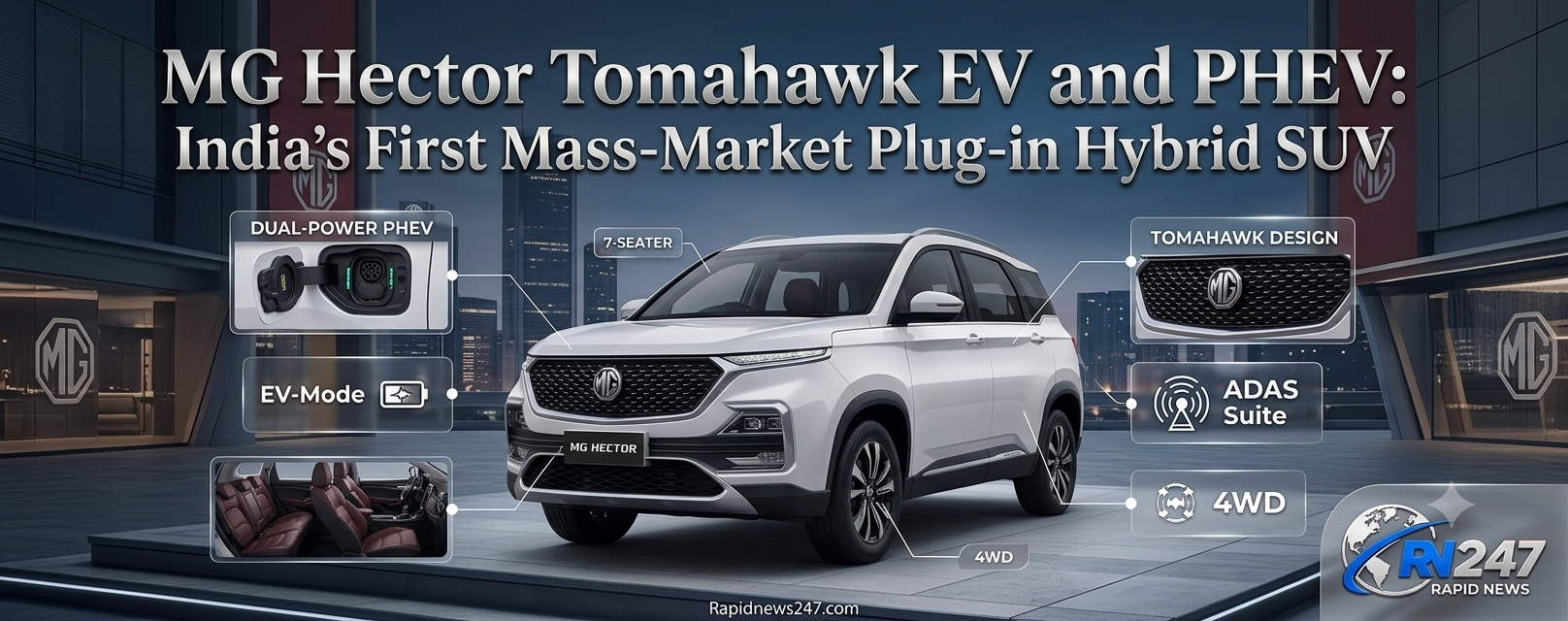
Introduction
MG Hector Tomahawk EV and PHEV: India’s First Mass-Market Plug-in Hybrid SUV Indian SUV buyers have generally faced a straightforward but frustrating choice: go fully electric and accept some charging-related compromise, or stick with petrol and keep paying at the pump every time prices climb.
MG Motor India‘s new Hector Tomahawk range is built specifically to remove that choice. Launched as a dual offering—a fully electric Hector Tomahawk EV and a plug-in hybrid Hector Tomahawk PHEV—the new seven-seat SUV range is now moving into its next phase, with test drives, showroom displays, and customer deliveries scheduled through September 2026.
What makes this launch genuinely significant isn’t just the badge — it’s the platform underneath it. The Hector Tomahawk PHEV is India’s first mass-market, mass-produced plug-in hybrid SUV, and both versions ride on MG’s newly developed ADAPT architecture, a “Multi-NEV” platform engineered to support electric, plug-in hybrid, conventional hybrid, and range-extender powertrains from a single base design. Here’s what buyers actually need to know.
What Is the Latest Update?
MG has launched both the Hector Tomahawk EV and Hector Tomahawk PHEV in India, with the PHEV positioned as the range’s headline feature: a seven-seat SUV that can run purely on electric power for daily use while retaining a petrol engine for longer trips without needing to plan around charging stops. Deliveries for the EV variant are scheduled to begin in September 2026, with test drives and showroom units also rolling out this month; PHEV customer deliveries follow shortly after.
Why Is This Car News Trending?
This launch is generating attention for a few concrete reasons. First, it’s a genuine segment first for India — the PHEV format has been talked about for years but never brought to market at mass-market pricing until now. Second, the dual-powertrain strategy on one platform is unusual; most manufacturers pick one path per model rather than offering both EV and PHEV versions of the same SUV. Third, the timing places it directly against two of the most-discussed electric SUVs of the year, the Mahindra XEV 9S and Tata Harrier EV, making head-to-head comparisons a natural and active search topic right now.
Price and Launch Details
MG Hector Tomahawk EV:
- Standard price: starts at ₹19.49 lakh (ex-showroom)
- Battery-as-a-Service (BaaS) price: starts at ₹13.99 lakh + ₹4.90/km battery rental
- Available in Excite, Exclusive, and Essence variants, in both 5-seater and 7-seater layouts
- Deliveries: from September 2026
MG Hector Tomahawk PHEV:
- Standard price: ₹25.69 lakh to ₹27.79 lakh (ex-showroom), across Exclusive and Essence variants
- Battery-as-a-Service (BaaS) Price: starts at a ₹21.79 lakh + 3.20/km battery rental
- Offered exclusively as a 7-seater
- Deliveries: EV deliveries begin in September 2026; PHEV deliveries follow, with one detailed review citing a November 2026 start — buyers should confirm exact timing with their nearest dealership, as it may vary by variant and demand.
The Battery-as-a-Service model is worth understanding before comparing prices directly with rivals: it separates the battery cost from the vehicle’s upfront price, lowering the initial purchase cost in exchange for an ongoing per-kilometre battery rental charge. This can make the entry price look significantly lower than the standard purchase price, so buyers comparing “starting prices” across brands sh ould check whether they’re comparing BaaS figures or full-ownership figures.
Engine, Battery, Performance and Range
Hector Tomahawk EV:
- 69.2k Wh battery pack, paired with a motor producing 201bhp and 310Nm of torque
- Front-wheel-drive only
- 0–100 km/h in 8.2 seconds
- MIDC-claimed range: 517km on a single charge
- DC fast charging: 30%–80% in approximately 35 minutes (90 kW charger)
- AC charging: 10%–100% in around 12.5 hours (7.4 kW charger)
Hector Tomahawk PHEV:
- 1.5-litre naturally aspirated petrol Dedicated Hybrid Engine producing 102PS and 125Nm, claimed to achieve 43.2% thermal efficiency
- Electric motor adding 201PS and 237Nm
- 20.5kWh battery pack
- Power delivered through what MG describes as the world’s first electromagnetic Dedicated Hybrid Transmission (DHT), rated at 98.8% transmission efficiency
- Pure-electric range: over 115km
- Combined range (electric + petrol): claimed at over 1,100km
- DC fast charging: 30%–80% in approximately 35 minutes (25kW charger)
- AC charging: 10%–100% in around 7.5 hours (3.3kW charger)
These are manufacturer-claimed figures under standard test conditions; real-world range and mileage will vary based on driving style, load, and route.
Features and Technology
Both variants share the Hector Tomahawk’s broader technology package, which includes:
- A 15.6-inch infotainment display — among the largest in its segment at launch
- i-SMART connected car technology with Gen AI functionality
- Segment-first “i-SWIPE” touch gesture controls
- Wireless Android Auto and Apple CarPlay connectivity, plus wireless phone charging
- Multiple drive modes, including Pet Mode, Valet Mode, Camp Mode, and Energise Mode on the EV
- Vehicle-to-Load (V2L), Vehicle-to-Home (V2H), and Vehicle-to-Vehicle (V2V) power-sharing support on the EV — a feature set not currently matched in full by its direct rivals
Safety Features
Both the EV and PHEV come equipped with six airbags, Level 2 ADAS (including adaptive cruise control, automatic emergency braking, and forward collision warning), a 360-degree camera, Electronic Stability Control, tyre pressure monitoring, and ABS with EBD. MG states the vehicles are built to global safety standards, but the official Bharat NCAP crash-test rating has not yet been published for either variant — MG’s own materials note this rating “will be shared once certified.” Buyers prioritising a confirmed safety rating should treat this as pending information rather than assumed.
Design and Interior
The Hector Tomahawk’s exterior design includes distinctive R18 dual-tone precision-cut alloy wheels inspired by a supercharger rotor motif, dynamic LED tail lights set into a sculpted rear bumper, and a touch-button tailgate release. Inside, the PHEV is offered exclusively as a seven-seater with 192 litres of boot space with all rows in use, expanding to 528 litres with the third row folded — practical for family use without sacrificing luggage space entirely, even in the largest seating configuration.
Rivals and Competition
The Hector Tomahawk EV and PHEV enter a genuinely crowded field of seven-seat electric and electrified SUVs in India, including:
- Mahindra XEV 9S — starts around ₹19.95 lakh, offering up to 79kWh battery options and rear-seat comfort features including tablet holders and reclining seats
- Tata Harrier EV — priced from roughly ₹21.69 lakh to ₹30.43 lakh
- Mahindra BE 6 — starts around ₹18.90 lakh
- Tata Sierra EV — starts around ₹18.79 lakh
- VinFast VF7 — starts around ₹22.99 lakh
Independent comparisons note that while the Mahindra XEV 9S offers more traditional, familiar SUV styling reminiscent of the XUV700, the Hector Tomahawk EV counters with its V2L/V2H/V2V power-sharing support and larger infotainment display — features not matched in full by its closest rival at launch. The Hector Tomahawk EV’s front-wheel-drive-only layout and LFP battery chemistry (which caps DC fast-charging speed at 90kW, lower than some NMC-battery rivals) are cited as trade-offs to weigh against those advantages.
What Makes This Car Interesting for Indian Buyers?
For buyers hesitant about committing fully to an EV due to charging infrastructure concerns, the PHEV variant offers a genuinely practical middle path: enough electric-only range for most daily commuting, with the petrol engine available as backup for longer, unplanned trips. The BaaS ownership model also lowers the initial cash outlay for buyers who want electrified motoring without the full upfront cost of the battery, though the ongoing per-kilometre charge needs to be factored into total cost of ownership over several years, not just compared against the sticker price.
What We Know So Far
Confirmed:
- Official pricing for both EV and PHEV variants (standard and BaaS)
- Battery capacities, motor output, and manufacturer-claimed range figures for both variants
- Core feature set, including V2L/V2H/V2V support and the 15.6-inch display
- Deliveries beginning in September 2026 for the EV variant
Reported / Expected:
- Exact PHEV delivery start date (one detailed source cites November 2026, differing from the general September 2026 timeline associated with the EV)
- Real-world range figures, which typically differ from manufacturer-claimed test-cycle numbers
Pending / Unconfirmed:
- Official Bharat NCAP crash-test rating for either variant
Frequently Asked Questions
1. What is the price of the MG Hector Tomahawk in India?
The EV starts at ₹19.49 lakh (ex-showroom), while the PHEV starts at ₹25.69 lakh. Both are also available at lower entry prices under MG’s Battery-as-a-Service scheme.
2. What is the range of the MG Hector Tomahawk PHEV?
MG claims a combined range of over 1,100km, including more than 115km of pure-electric driving, on a full battery and full tank.
3. What is the range of the MG Hector Tomahawk EV?
517km on a single charge, based on the MIDC test cycle.
4. What is the difference between the Hector Tomahawk EV and PHEV?
The EV is a pure battery-electric SUV available in 5-seat and 7-seat layouts, while the PHEV combines a petrol engine with a plug-in battery and is offered only as a 7-seater, aimed at buyers who want electric-only daily driving with petrol backup for longer trips.
5. When will the MG Hector Tomahawk be delivered?
EV deliveries begin in September 2026. PHEV deliveries follow, though the exact start date has varied slightly between sources — buyers should confirm with their dealership.
6. Does the MG Hector Tomahawk have a crash-test safety rating?
Not yet published. MG says the official Bharat NCAP rating will be shared once certified.
7. What are the main competitors of the MG Hector Tomahawk?
The Mahindra XEV 9S, Tata Harrier EV, Mahindra BE 6, Tata Sierra EV, and VinFast VF7 are its closest rivals in the Indian market.





:%20Every%20EV%20Worth%20Waiting%20For)