
 Shubham Singh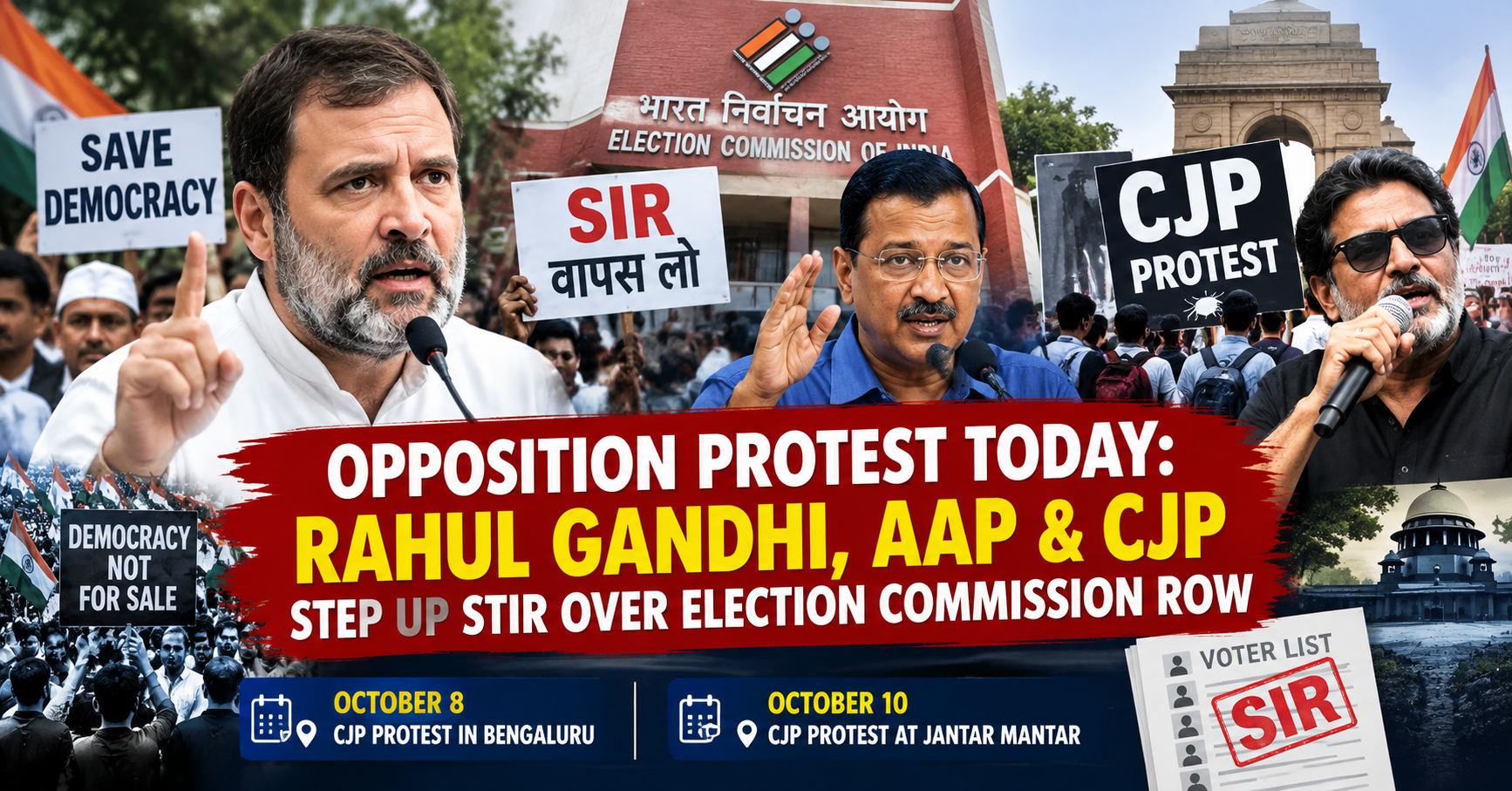
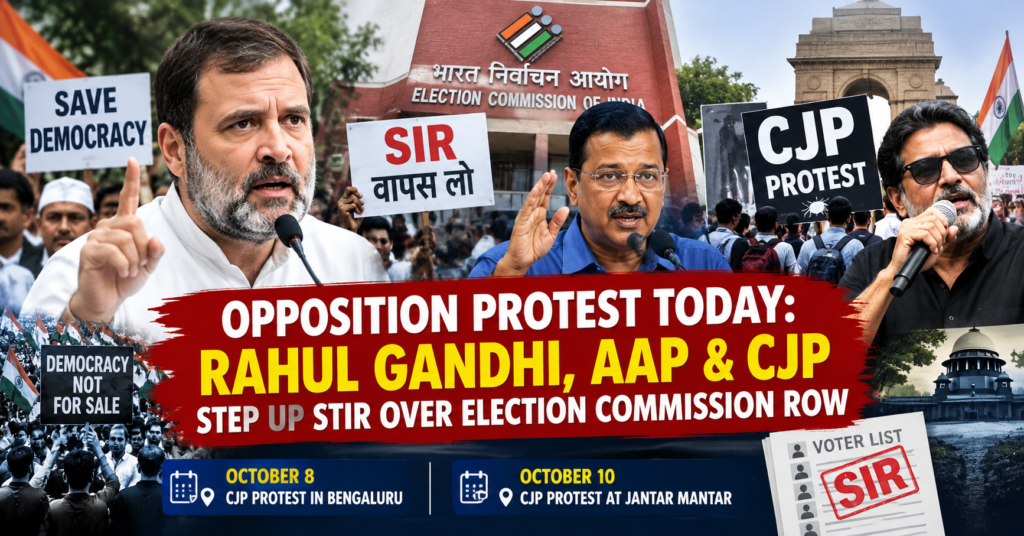
New Delhi: Political tensions over India’s electoral-roll revision process intensified this week as opposition parties and civil society groups stepped up protests against Chief Election Commissioner (CEC) Gyanesh Kumar and the Election Commission of India (ECI).
The latest developments come after Congress leader Rahul Gandhi and several INDIA bloc leaders staged a prolonged protest in New Delhi on October 6, followed by an AAP-led demonstration on October 7. At the same time, the Cockroach Janta Party (CJP) has announced further protests in Bengaluru on October 8 and at Delhi’s Jantar Mantar on October 10.
The protests are centred largely on the Special Intensive Revision (SIR) of electoral rolls and allegations of irregularities in the voter-list revision process. The Election Commission and the government have rejected allegations of political manipulation.
Rahul Gandhi Leads Opposition Protest in Delhi
Rahul Gandhi led a major opposition protest in New Delhi on October 6, with INDIA bloc MPs attempting to march from Parliament towards the Election Commission headquarters.
The protesters demanded a meeting with the Election Commission and called for the resignation of CEC Gyanesh Kumar over their concerns regarding electoral-roll revisions.
The march was stopped by Delhi Police near Akashvani Bhawan, a short distance from the Election Commission’s office. Rahul Gandhi, Priyanka Gandhi Vadra and other Congress leaders subsequently remained at the location for several hours.
The standoff continued for around nine hours before police detained Rahul Gandhi, Priyanka Gandhi and other protesters. Several Opposition MPs had also been detained earlier during the attempted march.
Rahul Gandhi has repeatedly used the phrase “vote chori” while alleging that electoral processes need greater transparency. The Opposition has also demanded that the Election Commission address its concerns over SIR.
The BJP, however, has criticised the protests and rejected the Opposition’s allegations.
AAP Joins the Protest Movement
The Aam Aadmi Party has also stepped up its campaign against the Election Commission.
AAP Delhi chief Saurabh Bharadwaj announced that party leaders and workers would participate in a protest outside the Delhi Chief Electoral Officer’s office over the voter-list controversy.
The party has said it will continue raising concerns over what it describes as “vote theft” and electoral transparency.
The participation of AAP adds another dimension to the growing street-level opposition campaign, although participation by different parties in individual demonstrations has not always been uniform.
What Is the SIR Voter-List Controversy?
At the centre of the political dispute is the Special Intensive Revision, or SIR, of electoral rolls.
The Election Commission says voter-list revision is intended to identify and remove duplicate, deceased or otherwise ineligible entries and ensure that electoral rolls remain accurate.
Opposition parties and several civil-society groups have raised concerns about the process, particularly over documentation requirements and the possibility that eligible voters could be left off electoral rolls.
The controversy has therefore developed into a wider political dispute over voter rights, electoral transparency and the independence of India’s election machinery.
The Election Commission has rejected allegations of wrongdoing. Following the October 6 protest, the ECI said that no political party had sought an appointment with the Commission through the prescribed procedure until 4 pm. It later received information about a proposed delegation of MPs but said the request did not follow its normal protocol.
CJP Plans Protest in Bengaluru on October 8
The protest campaign is also moving beyond Delhi.
The Cockroach Janta Party (CJP) has announced a programme in Bengaluru on October 8.
According to reports, CJP representatives are expected to participate in a People’s Tribunal on SIR at Freedom Park. The event is intended to provide a platform for people to raise concerns about voter-list changes and alleged deletions.
The programme is expected to focus particularly on voters classified under categories including Absent, Shifted, Dead, Duplicate and Others (ASDDO).
CJP has also announced what it calls a “Chappal Protest” in Bengaluru in solidarity with women who have raised allegations concerning police conduct. Actor Prakash Raj is among those expected to participate in the Bengaluru programme.
The October 8 programme could therefore become another important point in the expanding campaign around the SIR controversy.
CJP Announces Major October 10 Protest at Jantar Mantar
The CJP has also announced a larger demonstration in Delhi for October 10.
CJP founder Abhijeet Dipke has said that supporters from across India will march to Jantar Mantar if CEC Gyanesh Kumar does not resign.
The proposed protest is being described by the group as a major mobilisation against the Election Commission and the SIR process.
CJP leaders have said they intend to continue with the demonstration even if they face restrictions or difficulties obtaining permission. CJP co-convener Ashutosh Ranka has said the organisation intends to march towards Jantar Mantar and continue its demonstration.
The October 10 demonstration would be the group’s second major protest at Jantar Mantar following its earlier mobilisation in Delhi.
More Student Groups to Join October 10 Protest
The October 10 mobilisation could involve more than CJP.
Several Left-leaning student organisations, including SFI, AISF, AISA, PSU and AISB, have announced that they will join the protest at Jantar Mantar.
The groups have demanded the resignation of CEC Gyanesh Kumar and called for the SIR exercise to be scrapped. They have also raised concerns about police action during recent demonstrations.
This could turn the October 10 event into a broader gathering involving political activists, student organisations and civil-society groups.
Security Tightens Ahead of October 10 Protest
With the October 10 demonstration approaching, security arrangements in central Delhi are also becoming an important part of the story.
Delhi Police has increased security around Parliament Street and nearby areas as CJP representatives prepare to approach authorities regarding permission for their proposed march to Jantar Mantar.
CJP leaders have also claimed that some of their members could face arrest before the October 10 demonstration. These claims have been made by CJP representatives and should be distinguished from confirmed police action.
What Happens Next?
The political dispute over SIR is unlikely to end with the October 6 and 7 protests.
The October 8 Bengaluru programme and the October 10 Jantar Mantar mobilisation could bring the issue back into national focus, particularly if large numbers of protesters participate.
The key issues remain the accuracy of electoral rolls, the rights of eligible voters, the implementation of SIR and the Opposition’s demand for greater transparency from the Election Commission.
At the same time, the Election Commission maintains that electoral-roll revision is part of its constitutional responsibility and has rejected accusations of political bias or manipulation.
Conclusion
The Opposition’s campaign against the Election Commission has entered a new phase, with protests now spreading across political parties, student organisations and civil-society groups.
Rahul Gandhi’s prolonged protest in Delhi, AAP‘s mobilisation and the CJP’s planned programmes in Bengaluru on October 8 and Delhi on October 10 have kept the SIR controversy firmly in the national spotlight.
The next major focus will be the October 10 Jantar Mantar protest, where CJP and other participating groups are expected to press their demands over SIR and the leadership of the Election Commission.
As the protests continue, the debate is likely to remain centred on one fundamental question: How can India ensure that every eligible voter is accurately represented on the electoral roll while maintaining public confidence in the election process?

 Rohit Kamal